Key takeaways
- Splices and terminations are where cable systems usually fail, and the cause is usually preparation, not the product.
- Acceptance testing such as VLF withstand testing confirms the work before the system goes into service.
- Ask a splicing contractor about certification, testing capability and whether the manufacturer warrants their installs.
A medium voltage cable can run for decades with no trouble. The weak points are the places where people cut it open: splices and terminations. In the 5kV to 35kV range, the difference between a joint that lasts and one that fails is mostly in the preparation.
What a splice has to rebuild
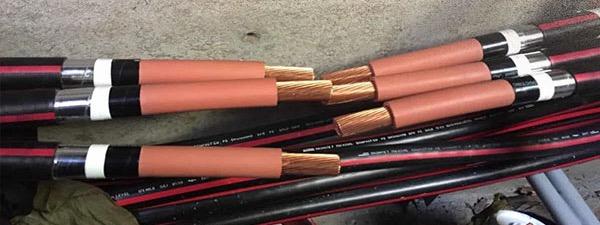
Shielded medium voltage cable is built in layers: conductor, conductor shield, insulation, insulation shield and a metallic shield or neutral. A splice or termination has to recreate each layer and control the electrical stress where the shield ends. Get any layer wrong and the field concentrates in one spot.
- Clean, square cuts and correct cutback dimensions for the kit
- Insulation shield removed without nicking or scoring the insulation
- No contamination: moisture, dirt or skin oils on the insulation surface
- Connectors crimped with the right tool and die for the conductor
- Stress control positioned exactly where the kit requires
- Shield and neutral continuity restored and grounded
Testing before energizing
New cable and accessories are normally acceptance tested before they go into service. Very low frequency (VLF) withstand testing, described in IEEE 400.2, is widely used for extruded cables. Tan delta and partial discharge tests add diagnostic detail. When a cable does fail, fault locating methods such as time domain reflectometry and surge (thumper) testing narrow down where.
Questions to ask a splicing contractor
| Ask | Why it matters |
|---|---|
| Who trained and certified your splicers? | Manufacturer and union training is specific to the kit and voltage class. |
| Do you test your own work? | Testing by the installer means problems are caught before the crew leaves. |
| Does the manufacturer warrant your installs? | Some programs give a factory warranty only to approved contractors. |
| Do you stock kits and cable? | On an outage, waiting for material is often the longest delay. |
D&M splicers work under Raychem's MVPower program, which carries a 20 year factory warranty on splices and terminations from 5kV through 35kV installed by D&M. We also stock splice kits and terminations from 5kV to 35kV in sizes from #4 to 2500 MCM.
Related capability
Medium Voltage Interconnections
5kV to 35kV interconnections for solar, wind, storage and EV charging, from radial feeders to network blockhouses.